I am familiar with the health care systems in many parts of the world. The best, in my opinion, has been the one in FRANCE and the most chaotic is in the USA. The most humanistic one, for a poor country, is in CUBA. and I must commend ISRAEL, UK, Australia and NZ among the countries I am familiar with.
USA has a broken system, and it is not correct to point the finger at any one but all people are responsible: The Fee for Service system without transparency, Insurance companies, Drug manufacturers and their peons, The Health administrators who are not normally conversant with Health Care, unlike in other countries. and the most important part, those instrumental in providing the Disease care, the Health Care Providers.
Even in that, it is so fragmented. You are not quite sure of the qualifications of the persons who are attending to you.
In the USA, with two years of extra education, Nurses can become Nurse Practitioners and persons with a Bachelors degree can be admitted to a PA Physician Assistant Programme of two years duration. Because of the system of fee for service, most of the Nurse Practitioners and Physicians Assistants work as Primary Care Providers.
Once again, it is the person and his characteristics that mark the qualities of a good care provider.
In the wellness centre I am associated with, there are Massage Therapists, Fitness trainers and Physiotherapists. Every body agrees that as long as we keep the advise within the limits of our knowledge , there is less chance of false health information.
So it was interesting to read this publication from JAMA this morning.
Question Do practitioners understand the probability of common clinical diagnoses?
Findings In this survey study of 553 practitioners performing primary care, respondents overestimated the probability of diagnosis before and after testing. This posttest overestimation was associated with consistent overestimates of pretest probability and overestimates of disease after specific diagnostic test results.
Meaning These findings suggest that many practitioners are unaccustomed to using probability in diagnosis and clinical practice. Widespread overestimates of the probability of disease likely contribute to overdiagnosis and overuse.
HIGHLIGHTS
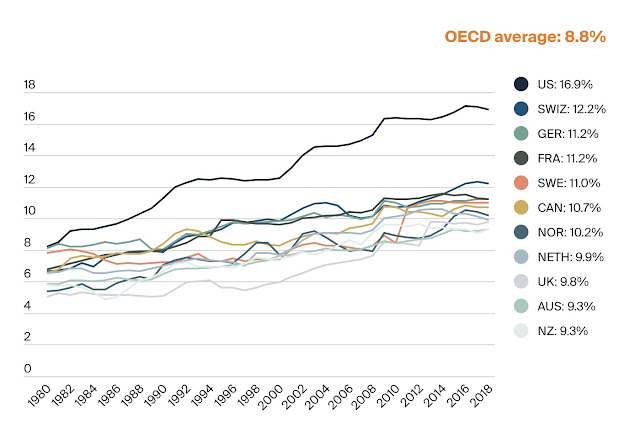
- The U.S. spends more on health care as a share of the economy – nearly twice as much as the average OECD country – yet has the lowest life expectancy and highest suicide rates among the 11 nations.
- The U.S. has the highest chronic disease burden and an obesity rate that is two times higher than the OECD average.
- Americans had fewer physician visits than peers in most countries, which may be related to a low supply of physicians in the U.S.
- Americans use some expensive technologies, such as MRIs, and specialized procedures, such as hip replacements, more often than our peers.
- The U.S. outperforms its peers in terms of preventive measures – it has the one of the highest rates of breast cancer screening among women ages 50 to 69 and the second-highest rate (after the U.K.) of flu vaccinations among people age 65 and older.
- Compared to peer nations, the U.S. has among the highest number of hospitalizations from preventable causes and the highest rate of avoidable deaths.
-

USA also has highest rate of spending money on Health (or Disease?) but do not have good indicators of health to show for it.
- An analogy came to my mind. A few years ago no one wanted to talk about Climate Change and slowly people began to accept that there is a crisis. In the USA there is a crisis in the health care sector, but no one wanted to talk about it and murmurs are being heard that the system is broken. So there is still hope!

Original Blogger URL: https://medicoanthropologist.blogspot.com/2021/04/over-diagnosis-among-american-health.html