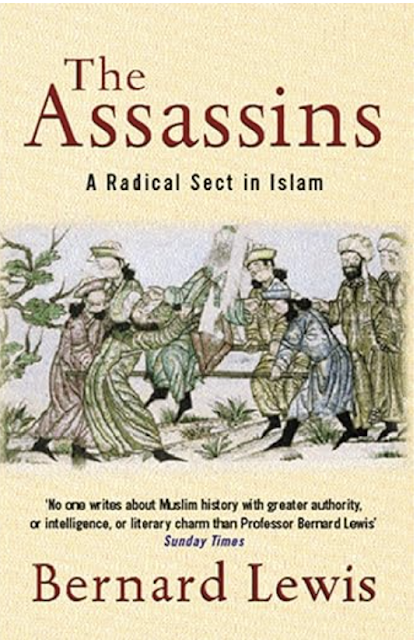
ASSASSINS
Have you ever wondered about the etymological origin of the word assassin?
Two key names frequently arise in historical accounts-whether you’re reading The Assassins by the distinguished historian Bernard Lewis or the beautifully crafted novel Samarkand by the erudite French-language writer Amin Maalouf. While the term is often casually linked to “hashish-eaters,” any serious student of Middle Eastern history would quickly dismiss that oversimplification.

The so-called “Order of Assassins”-more accurately known as the Nizari Ismailis-was an Islamic sect. According to texts from Alamut, their stronghold in Persia, their leader Hassan-i Sabbah referred to his followers as Asāsīyūn (أساسيون), meaning “those who are faithful to the foundation [of the faith].” However, foreign travelers and chroniclers misunderstood or deliberately distorted the term, erroneously associating it with hashish.
Hassan-i Sabbah, a prominent Ismaili from Qom, is a central figure in this sect’s complex history, which falls within the broader Ismaili branch of Shia Islam. I was especially intrigued by the story of Nizam al-Mulk, the Grand Vizier of the Seljuk Empire, who tragically became one of the Assassins’ most notable victims.
Conversely, I found it difficult to sympathize with Hassan-i Sabbah himself-a figure whose methods and ideology seemed to embody a darker side of his time, and perhaps even of ours.
As children, we were taught about the Ismailis in a far more benevolent light-largely due to the Aga Khan and his well-known philanthropy. I’ve had the pleasure of meeting several Ismaili merchants in Zanzibar, and those encounters only enriched my perspective.
History becomes even more captivating when a region enters your soul. In such moments, its stories don’t just inform you-they embrace you.
Original Blogger URL: https://medicoanthropologist.blogspot.com/2025/07/assassins.html