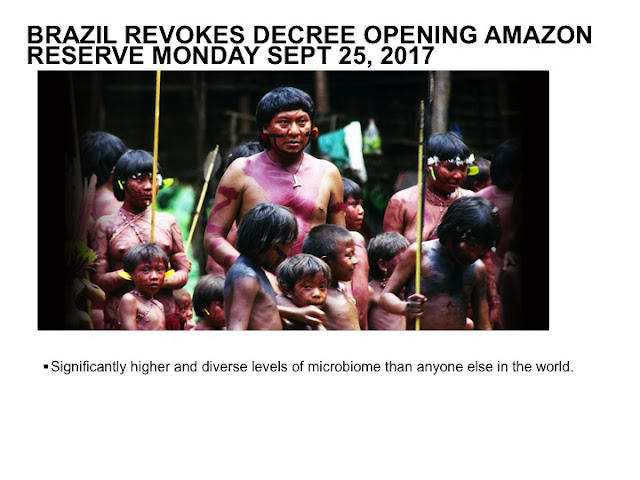
I am constantly thinking about ways of improving the deteriorated health, after contact with Europeans, of the Indians.
When visiting the Amazon, was happy to observe that the Yanomami and Ticuna have not lost their fantastic diversity of their gut flora, by adhering to their traditional diet and life. As a Ticuna said to me: among ourselves we speak Ticuna because we are Ticuna, we speak Spanish or Portugese with outsiders to communicate with them.

It was Hannibal my boatman in the Amazon who said to me: Outsiders think that when they cut down a tree in the forest, they are cutting down just one tree, but they are destroying many other things: insects, little plants and other depending upon that tree.
I thought: same with the Microbiome, when you are destroying a part of your microbiome with your Americanized Diet (processed food, fast food, inflammatory cooking oils, snacks and power drinks), you are loosing much of the diversity of your microbiome and thus a good part of your metabolic health.


Persistent microbiome alterations modulate
the rate of post-dieting weight regain
(published in NATURE 22/12/2016
In tackling the obesity pandemic, considerable efforts are devoted to the development of effective weight reduction
strategies, yet many dieting individuals fail to maintain a long-term weight reduction, and instead undergo excessive
weight regain cycles. The mechanisms driving recurrent post-dieting obesity remain largely elusive. Here we identify an
intestinal microbiome signature that persists after successful dieting of obese mice and contributes to faster weight regain
and metabolic aberrations upon re-exposure to obesity-promoting conditions. Faecal transfer experiments show that the
accelerated weight regain phenotype can be transmitted to germ-free mice. We develop a machine-learning algorithm
that enables personalized microbiome-based prediction of the extent of post-dieting weight regain. Additionally, we
find that the microbiome contributes to diminished post-dieting flavonoid levels and reduced energy expenditure, and
demonstrate that flavonoid-based ‘post-biotic’ intervention ameliorates excessive secondary weight gain. Together,
our data highlight a possible microbiome contribution to accelerated post-dieting weight regain, and suggest that
microbiome-targeting approaches may help to diagnose and treat this common disorder.
Now to do some looking into POST-BIOTIC nutritional intervention! appropriate for the Omaha tribe of Nebraska!
I had always suspected and in fact my interest in Microbiome was kindled by the observation that patients who went gastric by pass surgery had metabolic improvements even before they lost weight.
Here is a summary of a study published in June 2017, from Arizona State University (summary from Diabetes.org.uk)
A new study, led by researchers at Arizona State University, reveals that gastric bypass surgery profoundly changes which microbes can survive and thrive in the human gut, in turn leading to weight normalisation.
This change in the way in which constituent parts of the microbiome are interrelated or arranged impacts on the outcome of the procedure typically undergone by overweightpeople with type 2 diabetes or those who are obese.
So far, it has been unclear to what extent those changes in the human microbiome matter, but we know from previous research that many diseases are linked to such changes in what’s called dysbiosis.
This study is one of the first to suggest that that these alterations can be beneficial too, with findings that echo a paperreleased last year by Israeli researchers on the “yoyo-effect” while dieting.
SO, move over Amerigo Vespucci, let the Turtle Island go back to its legitimate owners and their Microbiomes!
Original Blogger URL: https://medicoanthropologist.blogspot.com/2017/12/fantastic-research-from-prof-segal-and.html